
Brands With Deep Archives Worth Studying

Some brands accumulate not just collections but vocabularies — Helmut Lang's late-90s minimalism, Margiela's deconstruction, Raf Simons' youth-anchored romanticism. These are the labels whose archives are now studied like museum holdings.
- 01

Maison Margiela
France · 1988Maison Martin Margiela was founded in Paris in 1988 by Belgian designer Martin Margiela, who had spent the previous three years as Jean Paul Gaultier's right hand. The first collection — shown in a Place des Vosges car park — established the brand's vocabulary in a single afternoon: deconstructed tailoring, exposed seams, reused materials (the brand made a coat from old socks, dresses from broken china, sweaters from butcher's gloves), the four white stitches on the back of each garment as a discreet brand mark, and Margiela's own refusal to be photographed or interviewed.
- 02

Raf Simons
Belgium · 1995Raf Simons studied industrial design in Genk, Belgium and worked briefly as a furniture designer before encountering Maison Martin Margiela in 1991 — a meeting that redirected him entirely. He apprenticed under Walter Van Beirendonck, founded his own menswear label in 1995, and presented his first runway collection in 1997. The vocabulary was specific from the start: post-punk youth culture, contemporary art references, Belgian school deconstruction, slim teenage silhouettes, and an obsessive interest in graphics, music, and visual rebellion.
- 03

Comme des Garçons
Japan · 1969Rei Kawakubo founded Comme des Garçons in Tokyo in 1969 and presented her first Paris collection in 1981. That debut — a monochrome show of black, asymmetric, deliberately distressed garments — was so opposed to the era's body-conscious glamour that Western critics labeled it 'Hiroshima chic'. Kawakubo was unbothered: she had announced a new grammar for clothing, one built on void, rupture, and the dignity of the unfinished.
- 04
Yohji Yamamoto
France · 1981Yohji Yamamoto was born in 1943 in war-torn Tokyo and raised by a single mother who survived as a dressmaker. He trained in law at Keio before switching to Bunka Fashion College in 1966; in 1972 he launched his own label, and in 1981 he showed in Paris alongside Rei Kawakubo. The reception was identical: confusion, then conversion. His clothes were black, oversized, deliberately worn-out, and engineered around movement rather than display — the absolute opposite of the Mugler-and-Versace decade that surrounded them.
- 05

Issey Miyake
Japan · 1970Issey Miyake (1938–2022) survived the Hiroshima atomic bombing as a seven-year-old and rarely discussed it; instead he built an entire career around the question of how a garment could best mediate between body, motion, and material. After training in graphic design and apprenticing with Guy Laroche and Hubert de Givenchy in Paris, he opened Miyake Design Studio in Tokyo in 1970, presented in New York in 1971, and joined Paris fashion week in 1973.
- 06

Rick Owens
Italy · 1994Richard Saturnino Owens was born in Porterville, California in 1961, dropped out of Otis Art Institute, and spent the 1990s pattern-cutting in Los Angeles' garment district while his then-partner (now wife and lifelong creative collaborator) Michèle Lamy ran a restaurant on La Brea. His clothes — drape-heavy, monochromatic, treated leather, sliced cashmere knits — circulated underground until Anna Wintour invited him to show in New York in 2002. He moved to Paris a year later, set up house and studio in a former Socialist Party headquarters near Place du Palais Bourbon, and never looked back.
- 07
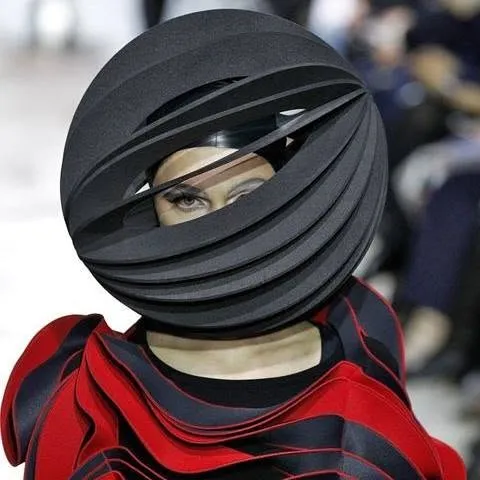
Junya Watanabe
Japan · 1992Junya Watanabe joined Comme des Garçons in 1984 as a patternmaker fresh out of Bunka Fashion College, became chief designer for the Tricot CdG line in 1987, and in 1992 was given his own runway slot within the COMME federation under Rei Kawakubo. The brief was essentially unbounded: take Kawakubo's avant-garde grammar and push it through your own concerns.
- 08

Ann Demeulemeester
Belgium · 1985Ann Demeulemeester graduated from the Royal Academy of Fine Arts in Antwerp in 1981, was one of the legendary 'Antwerp Six' who collectively rented a truck to bring their first collections to the 1986 British Designer Show in London, and founded her own house there immediately afterwards. The breakthrough was a 1992 Paris solo show. Her vocabulary was, and remains, instantly identifiable: monochrome (white, black, occasional bone), draped construction, asymmetric cuts, deconstructed tailoring, leather trousers, feathers, and a deeply felt punk-rock undercurrent inherited from her love of Patti Smith.
- 09
Undercover
Japan · 1990Jun Takahashi founded UNDERCOVER in 1989 with classmate NIGO (later of A Bathing Ape) while still a Bunka Fashion College student. The earliest collections were bootleg punk shirts sold from a Harajuku store called Nowhere; the label's first proper runway show was in Tokyo in 1994, with Takahashi pushing toward a vocabulary that fused British punk, dada-anarchic graphic experimentation, and a darkly romantic Japanese sensibility.